
Carbon County Scheduled Release Dates
A projected or scheduled date is a current calculation or official decision about when custody may end. It is not the same as the actual release timestamp. Staff may still need to clear a hold, apply an order, verify credit, arrange a transfer, or complete release processing. For Carbon County Jail, the county record should later supply the time and disposition that closed the booking. For a Utah prison case, UDC and the Utah Board of Pardons and Parole control different parts of the record.
A pretrial detainee usually has no sentence-based date to calculate. Release may depend on bond, a hearing, dismissal, plea, sentence, or another agency's hold. A person serving a fixed county-jail term may have a computed date based on the judgment, time already credited, jail calculation, and any valid hold. Utah state-prison terms are generally indeterminate, meaning the court imposes a legal range while the Board decides parole or termination within its authority.
Do not treat a missing roster row as the date. Carbon County posts a current-bookings table, not a release log, and it gives no public retention period for removed rows.
Find Carbon County Release Dates
Start by deciding whether the person is in the Carbon County Jail, a UDC prison or supervision case, or another custody system. The same name can move between agencies. A county booking number and UDC offender number are not interchangeable. The correct route also changes after full discharge because UDC's live offender search covers current UDC incarceration or supervision, not every person who once served a Utah sentence.
Use this order to locate the best available date:
- Check the Carbon County Current Bookings table to see whether the person still appears in county custody. Its
Arrivalvalue is not a release date. - For a county-jail term, call Carbon County Jail and ask for the jail's current calculation, the holds affecting it, and later the actual release timestamp.
- For a UDC case, search by UDC number or by at least one character of both first and last name, then open the matching record.
- Read UDC's exact Release Date/Type entry. A blank or
N/Aresult does not support an estimated date. - Review the Board's published decision for a parole date, termination date, contingency, rehearing, or rescission. A Tentative Hearing Date is only an estimated hearing month or year.
- For a past case no longer found in UDC search, use Board decisions, a UDC records request, and the sentencing court record.
The official UDC Offender Search below shows the name and UDC-number routes.
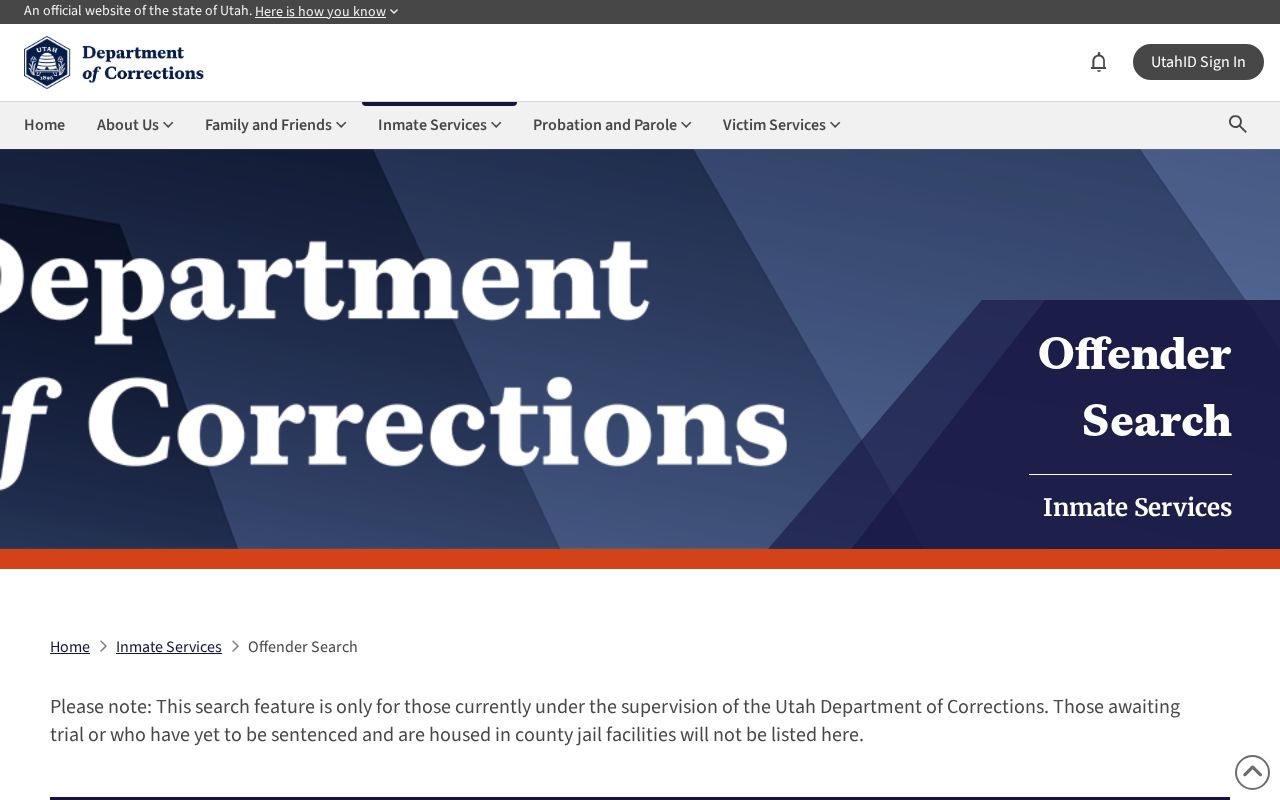
The search screen is only the entry point. Identity, scope, and the exact date label still need to be checked on the matching record.
Note: UDC search is for current state supervision and excludes an unsentenced Carbon County jail detainee.
Carbon County Jail Release Dates
Carbon County's live table displays last name, first name, booking number, arrival, and three hold fields. It has no projected, scheduled, or actual release field. Thus, an arrival date cannot be turned into a release date by subtracting a standard term. The underlying case may be pending, and the listed holds may delay or redirect release. A hold means another legal or agency claim on custody. It does not reveal the eventual outcome.
For a sentenced county-jail term, gather the written judgment, sentence start, jail credit, and booking number. Then ask the jail for its current calculation. Carbon County Jail can be reached at 435-636-3254, and its official details appear on the Sheriff and Jail page. If a court order or case change is central, the Carbon County Justice Court handles local class B and C misdemeanors, ordinances, and infractions, while Seventh District handles class A misdemeanors and felonies.
A court order can explain the legal basis for release without stating the precise time jail staff completed processing. When that exact time matters, request the booking and release record through Carbon County's GRAMA route. Ask for the actual release timestamp, release disposition or type, transfer destination if recorded, and any hold-clearance entries.
Carbon County Good-Time Calculations
Carbon County jail good time is not an automatic percentage and not a copy of state-prison earned time. Utah Code § 76-3-403 permits the custodial authority, in its discretion and for good behavior, to allow up to ten days per 30 days served for a qualifying term. For a term under 30 days, the maximum is up to two days per ten served. The rule applies to qualifying misdemeanor confinement unless the judge orders otherwise, or to jail confinement within a felony probation agreement unless the district judge orders otherwise.
Those are statutory ceilings, not a promise that Carbon County grants the maximum. The county publishes no local calculator, forfeiture or restoration rule, or weekend-adjustment policy. It would be false to place a public calculator on top of those unknowns. Work or school release under § 76-3-403.5 is also distinct. Time outside the jail under a controlled program does not mean final discharge.
This local distinction is the key Carbon County release-date quirk. There is no verified Utah rule that every county or state inmate serves about 85 percent. County-jail good behavior, a UDC case action plan, and a Board parole decision are separate paths with separate decision makers.
Note: Ask Carbon County Jail for its own calculation and treat the statutory maximum only as the outer limit for qualifying terms.
Utah Release-Date Terms
Exact labels prevent a common mistake. The live UDC detail uses Release Date/Type. UDC's public-information inventory separately lists Parole/Expiration Date among information that may be public. These two official inventories do not promise that every live result displays every public field. Records inspected during research sometimes showed N/A for Release Date/Type.
The Board's Tentative Hearing Date means an estimated month and year when a hearing may occur. It is not a projected release date. A Board decision may instead set parole, termination, a rehearing, an added requirement, or rescission. Rescission means the Board withdraws a date before release or withdraws a parole termination date before termination. The most recent controlling order matters.
| Official term | What it means |
|---|---|
| UDC Release Date/Type | The exact live UDC detail label; it may be blank or N/A. |
| Parole/Expiration Date | The label in UDC's broader public-information inventory. |
| Tentative Hearing Date | An estimated Board hearing month or year, not release. |
| Board parole date | A date set by an official Board decision, subject to contingencies or later action. |
| Actual release timestamp | The agency record of when release processing ended. |
The UDC public-information page documents the public inventory. For a live result, rely only on the fields actually shown and obtain UDC records when a needed item is absent.
Carbon County State Release Dates
Utah felony prison sentences are generally indeterminate. The court sets the lawful sentence range. The Board combines concurrent and consecutive terms to determine the total minimum and maximum, then makes parole and termination decisions within its legal authority. Board guidelines inform the decision but do not create a promised date. Utah Code § 77-27-9 generally bars parole before the minimum term unless the Board makes the stated findings and conducts the required full hearing.
Utah Code § 77-27-5.4 requires a Board earned-time program. Successful completion of each of up to two qualifying risk-reduction programs, approved with UDC and recommended in the person's case action plan, provides at least four months of credit. The Board may grant more in its discretion. Exclusions include inadequate transition time under an existing date, life without parole, an order to serve to expiration, no current release date, an unmet release contingency, or an existing Board termination date.
The official Utah earned-time statute capture below is the source for state-prison credit rules.
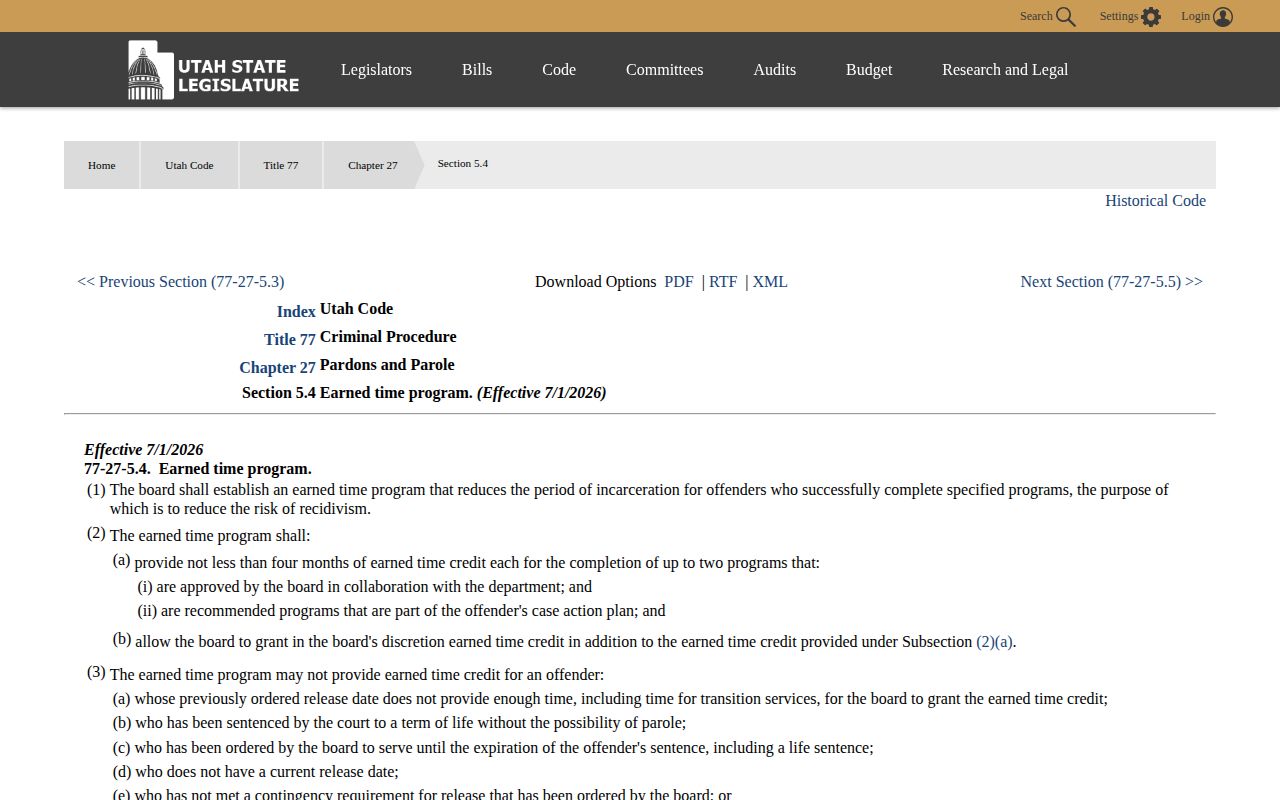
The statute supports a program credit, not a one-size-fits-all date. Earned time can also be forfeited when the Board determines a rescission hearing is needed.
UDC says state parole and release processing occurs on Tuesdays, mainly at Utah State Correctional Facility in Salt Lake City. Almost all state prisoners housed in a county jail return there for release. Direct release of such a state prisoner from a county jail is extremely rare. That state process should never be applied to an ordinary Carbon County jail sentence.
Why Carbon County Dates Change
A date is a snapshot of the controlling facts and orders at that time. Some changes correct the calculation. Others arise from new legal events. A receiving agency may also prevent a person from entering the community even when one custody event ends. The source should therefore show both the date and the type or disposition.
| Factor | Effect on the date |
|---|---|
| Jail credit correction | Changes the time credited toward a Carbon County sentence. |
| County good time | May reduce a qualifying term within the discretionary statutory limits. |
| Board earned time | May change a UDC release date after approved program completion and Board action. |
| Contingency | An unmet plan or condition can prevent release on the prior date. |
| Rescission or discipline | The Board may withdraw a release date before release after the proper process. |
| Warrant, detainer, or hold | May delay release or send the person to another authority. |
| Court or Board order | A later controlling order can set, change, or end the prior date. |
A detainer is a request or legal basis for another authority to take custody. It can turn the end of one jail episode into a transfer. For that reason, a future date never proves the person will walk out to the community on that day.
Confirm Carbon County Release Dates
For county custody, compare the jail calculation with the judgment and any current hold. After processing, obtain the actual release timestamp and disposition. For a UDC case, compare the live UDC entry with the latest Board order. If the person no longer appears because supervision ended, use the Board decision archive, UDC GRAMA records, and the sentencing case.
VINE can send a supported notice about one person, but it is not the certified record. The VINE Inmate Check explains Utah registration and Carbon County limits. For the wider sequence that distinguishes roster status, release records, court outcomes, and other custody systems, use the Carbon County released inmates lookup.
What if UDC shows N/A? Do not estimate from the sentence alone. Check the current Board order and ask UDC for the existing date or sentence record. If the person is in the Carbon County Jail, return to the county jail and court because UDC search excludes an unsentenced county detainee.
Note: The best confirmation pairs the latest official date with its type, controlling order, and final agency release record.