
Carbon Release Mugshot Records
A booking photograph records appearance during a specific arrest and booking event. It does not state the later release time, release type, court outcome, or present custody status. Carbon County's official jail table is current-only, and the table contains no photo field. A person may leave that list because of community release, transfer, a data correction, or another status event. The photo and release questions must therefore be researched through separate records.
Utah law does not make every requested image automatically available. A county sheriff must apply GRAMA classifications and the booking-photo rules in Utah Code § 17-72-802. GRAMA is the Government Records Access and Management Act. It permits access to public records while recognizing private, controlled, protected, sealed, and expunged material. A records officer may deny an image or provide a lawful explanation and appeal route.
Carbon Release Mugshot Channels
Start with the agency that created the image. Carbon County Jail and UDC record different custody events, so their photographs are not interchangeable. VINELink can aid custody notification but no verified Carbon result screen established that it displays a photo. Official social posts and news may contain images from an incident, yet those copies do not certify release.
| Channel | Has photo? | How to access |
|---|---|---|
| Carbon Current Bookings | No photo column | Use only to check a current booking |
| Carbon County GRAMA | Possible, subject to law | Request the named booking photograph |
| UDC public information | Prison photo is listed | Use UDC public-information or GRAMA route |
| Utah offender registry | Only for covered registrants | Use solely for statutory registry cases |
| VINELink | Not verified for Carbon | Use for person-specific custody alerts |
| Official posts or news | Sometimes | Check context, date, identity, and source |
| Commercial copies | May persist | Do not treat as an official release record |
For a named person, match the booking number and approximate date before requesting an image. Then obtain the actual release record. That record can show whether the county event ended in release or transfer, while the image only ties to the booking. The Carbon County released-inmate search sets out the county, court, state, and federal verification order.
Carbon Roster Has No Mugshots
The Carbon County Jail Bookings page displays seven fields: last name, first name, booking number, arrival, and three hold fields. It has no photograph, charge, destination, release timestamp, or release type. Sorting or exporting the table cannot create the missing fields. A vanished row also cannot establish that the person left during a chosen time window.
No official Carbon sheriff inmate app, mugshot app, recent-release archive, or photo roster was found. The official route for a county booking image is therefore a focused records request. The Carbon County 24-Hour Releases coverage explains why the live table cannot be turned into a same-day release feed.
View the official Carbon Current Bookings table to identify a current row and booking number.
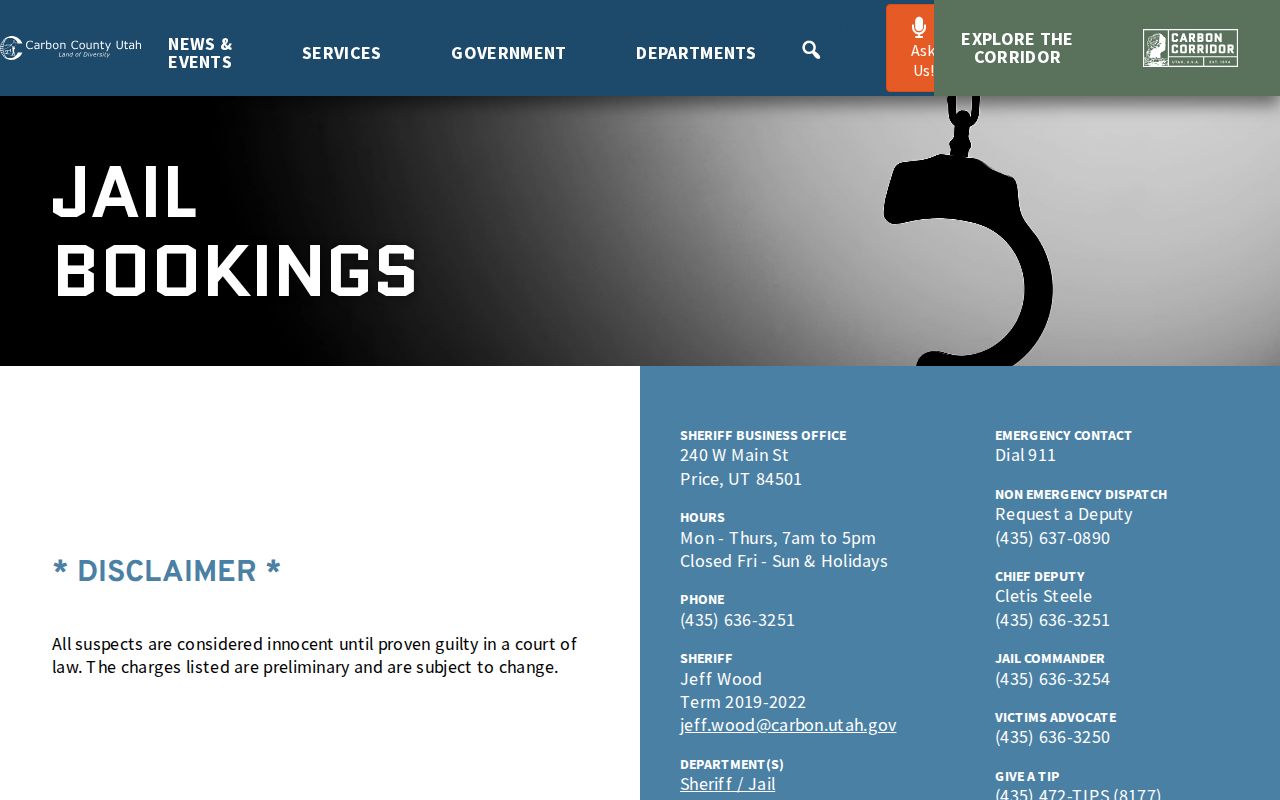
The captured table confirms the narrow current-custody fields and the absence of any published booking-photo or release column.
Note: Carbon roster removal is a search lead, not proof of a release date, release type, or transfer destination.
Request Carbon Booking Mugshots
Carbon County appoints the County Clerk as records officer. A written Carbon County GRAMA request may be submitted online, in person, or by mail. The related records-request route also describes email, fax, and Utah's Open Records Portal. Ask for an existing photograph tied to a specific booking rather than a broad search or a new analysis.
Supply enough detail to separate people with similar names. Carbon County does not publish a flat booking-photo fee or a photo retention period. Inspection is free. Copies, scans, and actual processing may be charged, and the county says processing cost may apply after the first 15 minutes. Its ordinary response description is within ten business days unless an allowed circumstance changes the timing.
- Identify the full name, date of birth if known, booking number, and approximate booking period.
- Request the specific booking photograph and, if useful, the matching booking and release record.
- State a preference for an electronic copy and ask for a cost estimate before a chosen limit.
- Sign the non-publish-for-pay affirmation required for a sheriff copy under Utah law.
- If access is denied, ask for the record classification, legal basis, and appeal instructions.
Review Carbon County's submission and response routes before sending the request.

The official page shows where a focused booking-photo request enters the county records process.
Requesting the matching release fields can prevent a common error. The admission timestamp identifies the start of the booking, while the actual release timestamp closes it. Release disposition distinguishes bond, time served, court order, transfer, or another recorded outcome. A destination or receiving-agency field, if maintained, helps show whether the person returned to the community. Carbon County does not guarantee that each field sits in one form, so describe the existing records sought and let the records officer identify responsive material.
Which Carbon Agency Owns It
Carbon County's roster publishes no booking photo, while UDC lists a prison photo or mug shot among public information. Those facts create three separate questions: whether an image exists, which agency created it, and whether that agency may release a copy. A Carbon County booking image documents county intake. A UDC prison photograph documents a different state-corrections event.
For a state-prison image, use the UDC public-information and GRAMA route. The current offender-search detail inspected during research did not expose a photo field, so the lack of a picture there is not proof that no prison image exists. Supply the person's name, date of birth, UDC number, and approximate dates.
The Utah offender registry is narrower. Its images apply only to people within statutory registration categories, and it is not a general Carbon County released-person photo database. Likewise, VINELink aids person-specific custody checks and notifications. Research did not verify a Carbon County photo field in its live result, so none should be assumed.
A release record and a photo may also have different access results. An agency might disclose identifying release fields while withholding an image under a valid classification, or it might maintain a state prison image that never appeared on the Carbon roster. Ask each office for its own record. Do not rename a UDC prison photo as a Carbon County booking mugshot merely because both relate to the same person.
Utah Rules for Carbon Mugshots
Utah Code § 17-72-802 requires a person seeking a sheriff's booking-photo copy to affirm that the image will not be placed in a publish-for-pay publication or site. The sheriff may not provide a copy for that use. Access can also be denied when GRAMA classifies the image as protected. A signed affirmation does not guarantee disclosure.
The statute separately governs removal by a publish-for-pay publisher. It generally requires removal and destruction within 30 calendar days after a request. When proof shows acquittal, nonprosecution, expungement, vacatur, or pardon, the period is seven calendar days, and payment cannot be demanded in that category. The general removal condition is capped by statute. These rules apply to the regulated publisher, not as a promise that Carbon County must disclose a protected photo.
Read the official Utah booking-photo statute before signing the required affirmation.
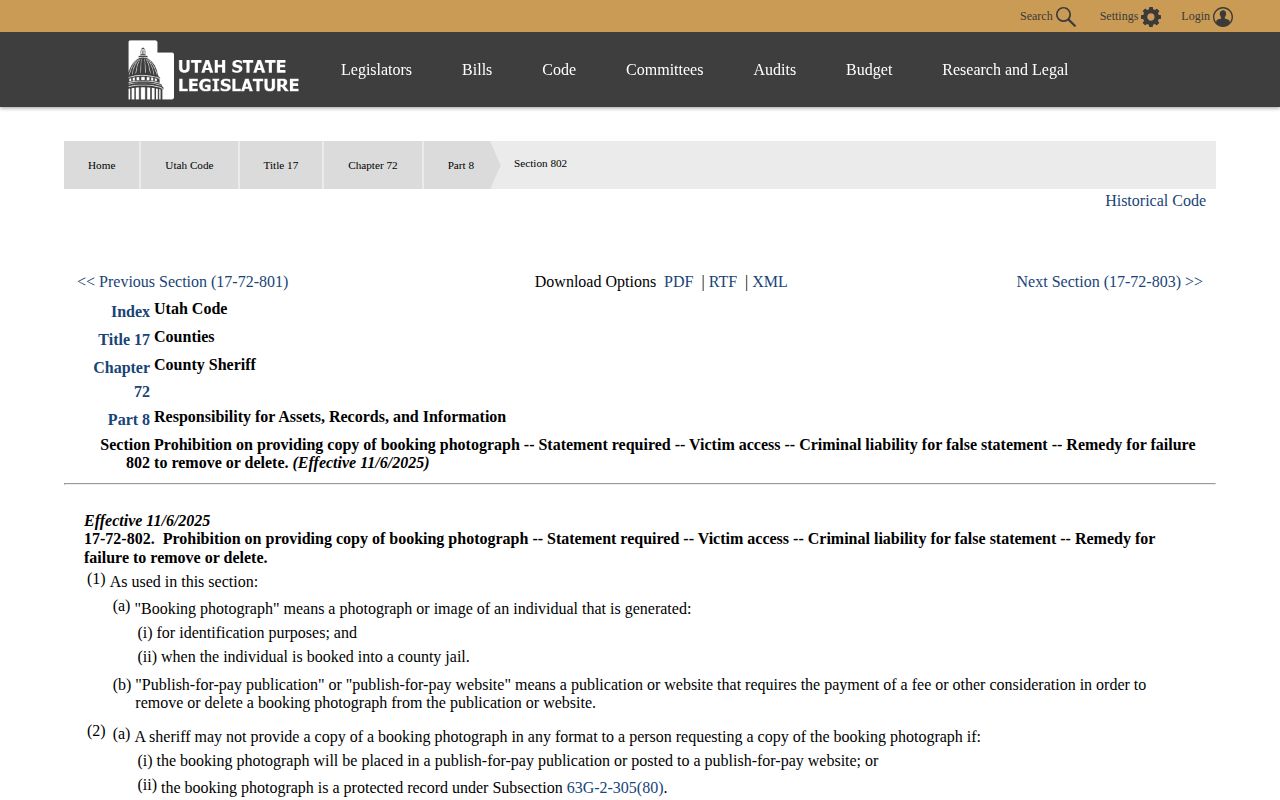
The statute image grounds the county-photo request in Utah's current affirmation, protection, and removal rules.
Note: A lawful request may still result in redaction or denial when the booking photograph is not classified as public.
Carbon Mugshots After Expungement
Utah expungement seals government records under a court and statutory process. Beginning January 1, 2026, courts resumed identifying qualifying automatic cases themselves; the temporary request-form process used in 2024 and 2025 ended. Petition-based cases have their own eligibility, completion, certificate, and filing rules. Automatic and petition routes should not be blended.
No Carbon-specific expungement clinic appeared in the Utah Courts directory reviewed for this project. The sound official routes are the Utah Courts expungement guide, Bureau of Criminal Identification resources, statewide Self-Help services, and the Utah State Bar Virtual Legal Clinic. A person should use the order and agency process that fit the case rather than assume an online image will change by itself.
Expungement affects access to government records according to law and the order. It does not erase independent news coverage. A source may also hold the wrong image or stale context. When seeking correction, identify the source, the exact image, the case or booking, and the official document that supports the request. Keep the photo question distinct from current custody and from the exact moment of release.
When an official source still shows an image after an order, contact the agency that controls that record and provide a copy of the order through its stated process. The county, court, UDC, and an outside publisher are separate custodians. One office cannot revise another source's copy. Preserve the request, response, and order so the record trail shows what was asked and which custodian answered.
Carbon Release Images in News
The sheriff's official site directs readers to the Carbon County Sheriff Facebook page for recent office information. An incident post may include a photograph or narrative. It is not a release ledger. The post date may reflect publication rather than booking, and a photo can remain online long after the custody event changed.
Government notices and established local news may also preserve an arrest-related image. Treat those sources as context. Compare the name, event date, and agency before assuming the image belongs to the person or booking at issue. Then confirm status through the jail release entry, court disposition, UDC record, Board order, or the applicable federal system. An old image does not show that someone is still held, and a new article does not prove when processing ended.
Commercial photo collections may keep stale copies, but they are not official Carbon County records. No commercial mugshot link is provided here, and no paid removal service is endorsed. The originating agency record remains the sound source for the image and its custody context.